

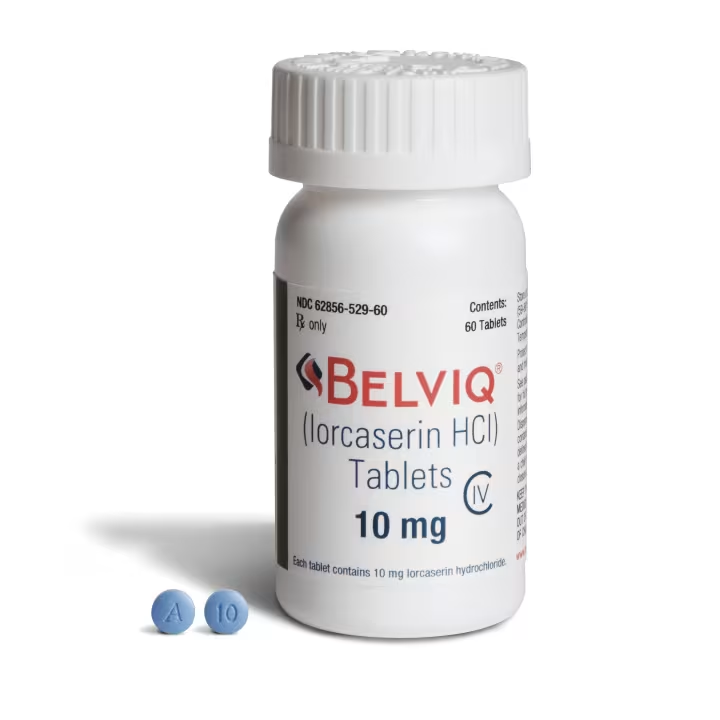
Belvic Weight Loss Drug Lawsuit
“The U.S. Food and Drug Administration (FDA) has requested that the manufacturer of Belviq, Belviq XR (lorcaserin) voluntarily withdraw the weight-loss drug from the U.S. market because a safety clinical trial shows an increased occurrence of cancer,” the FDA Drug Safety Communication states.
In response, Japanese drugmaker Eisai Inc., manufacturer of Belviq and Belviq XR, “has submitted a request to voluntarily withdraw the drug,” the FDA said.
The FDA has instructed patients presently prescribed Belviq or Belviq XR to stop taking the drug immediately and to properly dispose of any remaining tablets. At this time, the FDA is not recommending additional cancer screenings or other measures for patients who have been taking Belviq.
Belviq Weight Loss Drug Lawsuit What Is Belviq (lorcaserin)?
First approved by the FDA for release on the US market in 2012, Belviq (lorcaserin) is a prescription weight-loss drug belonging to a group of medications known as serotonin receptor agonists. When accompanied by a calorie-restricted diet and appropriate exercise, Belviq is believed to assist obese individuals with weight management by increasing feelings of “fullness” when eating, thereby reducing the number of calories consumed.
“Lorcaserin is used to help adults who are obese or who are overweight and have weight-related medical problems to lose weight and keep from gaining back the weight,” describes Medline Plus, a website from the US National Library of Medicine, part of the National Institutes of Health (NIH).
According to an analysis by Bloomberg News and Symphony Health Belviq achieved its top US sales numbers in 2015 when upwards of 600,000 prescriptions were filled. The same analysis shows that, a year earlier, Belviq manufacturer Eisai earned nearly $50 million in revenue from Belviq sales across North and South America.
Belviq (lorcaserin) Concerns Arise
“When approving lorcaserin, we required the drug manufacturer, Eisai Inc., to conduct a randomized, double-blind, placebo-controlled clinical trial to evaluate the risk of heart-related problems,” the FDA explained in an earlier Belviq drug safety communication, dated January 14. “In this trial, which was conducted in approximately 12,000 participants over 5 years, more patients taking lorcaserin were diagnosed with cancer compared to patients taking a placebo, which is an inactive treatment.”
While the FDA included in the January 14 communication the caveat that its “evaluation of this potential signal is ongoing, and at this time it is uncertain if lorcaserin increases the risk of cancer,” by a month later, on February 13, the FDA was recommending that Belviq be pulled from the US market completely.
A website formerly set up as a marketing platform for Belviq has now been replaced with a text-only statement from Eisai Inc.
“Eisai’s interpretation of the data from the CAMELLIA-TIMI 61 trial differs from that of the FDA,” Eisai’s statement says. “The Company’s assessment is that BELVIQ and BELVIQ XR continue to have a positive risk-benefit profile in the patient population for which they are indicated. However, based on the change in FDA’s risk-benefit assessment and as requested by the Agency, Eisai has agreed to voluntarily withdraw the products from the U.S. market.”
Eisai says its conclusions about Belviq’s safety are based on evidence gathered “in more than 30 clinical trials involving over 22,000 patients over the last 15 years.”
However, the company concedes that the FDA found the data gathered in the CAMELLIA-TIMI 61 trial troubling enough to request the drug be withdrawn from the market.
“Following its review of the data, FDA concluded that the potential risks of lorcaserin outweigh its benefits,” Eisai says. “More specifically FDA noted there was a numerical imbalance in the number of patients with malignancies. FDA’s analysis of the study found that during the course of the trial, 462 (7.7 percent) patients treated with lorcaserin were diagnosed with cancers compared to the placebo group, in which 423 (7.1 percent) patients were diagnosed with cancers.”
Potential For Legal Action
In the first lawsuit filed against the makers of Valsartan, plaintiffs Elizabeth Duffy and John Duffy filed a federal complaint in the Southern District of New York against two drug makers and two drugstore chains for their role in manufacturing, distributing, and selling generic valsartan-containing drugs that were contaminated with NDMA, a substance the US Environmental Protection Agency (EPA) has categorized as a “probable human carcinogen”.
The legal action, which was filed on behalf of the plaintiffs and all similarly situated consumers, accuses Solco Healthcare and Prinston Pharmaceutical of manufacturing and distributing the potentially harmful drugs and blames drugstores Walgreen Co. and Throggs Neck Pharmacy of selling the drugs to consumers.
Sources:
MedlinePlus. (Accessed 20 February 2020). Lorecaserin. MedlinePlus.gov. National Library of Medicine. National Institutes of Health
The Washington Post. (14 February 2020). Weight-loss drug Belviq pulled off U.S. market because of cancer concerns
United States Food and Drug Administration (FDA). (14 January 2020). Safety clinical trial shows possible increased risk of cancer with weight-loss medicine Belviq, Belviq XR (lorcaserin). Drug Safety Communications
Belviq.com. (Accessed 20 February 2020)
Johnson, L. (13 February 2020). Weight loss drug Belviq pulled from market over cancer risk. AP News