

Cartiva Toe Implant Lawsuit: Recall & MDL Failure Criteria
If you underwent a joint preservation procedure for big toe arthritis and are now suffering from chronic foot pain, joint stiffness, or bone erosion, you are not alone. The Cartiva Synthetic Cartilage Implant (SCI) was heavily marketed to patients as a revolutionary alternative to toe fusion surgery, promising to eliminate bone-on-bone friction while preserving full joint mobility.
However, real-world clinical data has exposed a devastating reality. At TheLawFirm.com, we are tracking national product liability claims alleging that the Cartiva implant suffers from catastrophic design defects. If your toe implant failed prematurely, it wasn’t simply a calculated surgical risk—it may have been a defectively manufactured device.
- ✔ Cartiva Toe Implant Surgery Between 2016 and 2024
- ✔ Ongoing Big Toe Pain, Stiffness, or Sinking
- ✔ Documented Device Subsidence, Shrinkage, or Loosening
- ✔ Revision Surgery Completed or Recommended (Joint Fusion)
How You Potentially Qualify
- Corrective Revision Surgery: You underwent secondary surgery to remove, repair, or replace a failed Cartiva hydrogel implant.
- Joint Fusion (Arthrodesis): Implant complications forced a permanent big toe bone fusion.
- Explicit Medical Recommendation: A physician formally documented device failure and advised removal.
- Strict Distribution Window: Initial operation occurred between July 2016 and October 2024.
We Are Not Accepting If:
- Retained Device Integrity: Implant functions properly with no secondary extraction or fusion advised.
- Pre-2016 Surgical Tracking: Operation occurred prior to wide-scale US commercial launch in 2016.
- General Post-Op Soreness: Minor recovery aches lacking objective diagnostic X-rays showing device breakdown.
The Hydrogel Defect: Why Cartiva Toes Fail
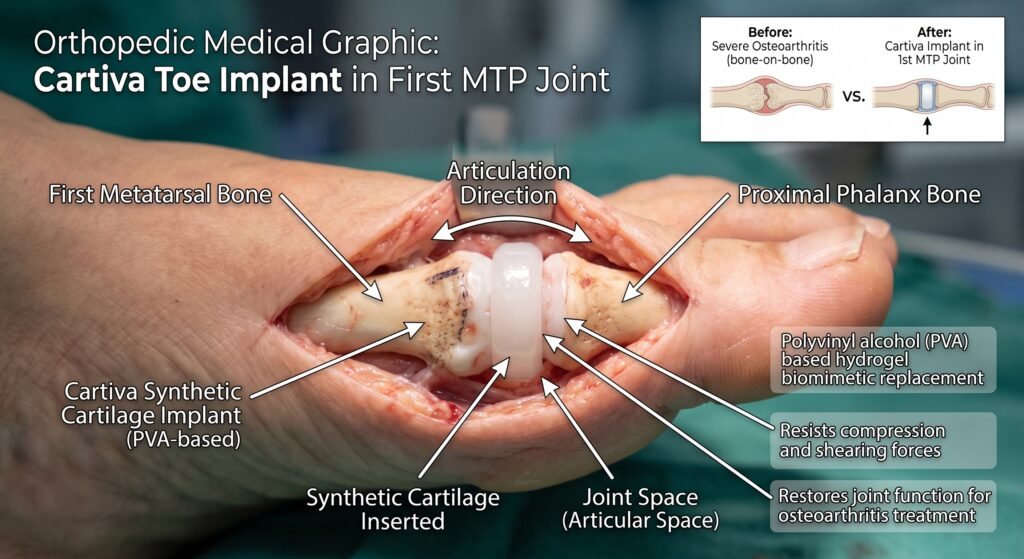
The Cartiva toe implant is a pre-molded cylindrical plug crafted from a polyvinyl alcohol (PVA) hydrogel polymer. It was engineered to mimic natural human cartilage, absorbing shock directly inside the metatarsophalangeal (MTP) joint. Unfortunately, post-market clinical reporting reveals that the hydrogel material behaves erratically inside the biological environment of the foot. Rather than remaining stable, the PVA material rapidly compresses, degrades, and shrinks over time.
This material degradation triggers a painful mechanical failure loop:
- Implant Subsidence (Sinking): As the hydrogel shrinks, the implant loses structural stability and sinks directly into the underlying metatarsal bone, causing bone-on-bone contact.
- Device Migration and Fragmentation: Unstable plugs dislodge into surrounding tissues or break into small plastic fragments, causing acute local inflammation, severe nerve damage, and cystic bone destruction.
While initial marketing materials boasted an “ultra-low” failure rate, peer-reviewed post-market tracking studies have identified real-world failure and complication rates climbing past 60% in select patient groups.
The 2024 Regulatory Recall & The 2026 Federal MDL
In October 2024, parent manufacturer Stryker Corporation issued an urgent Class II FDA Recall encompassing all sizes of the Cartiva Synthetic Cartilage Implant due to the undeniable spike in premature device failures. This enforcement action verified what injured patients already knew: the device carried unrepresented biological risks.
Because isolated lawsuits were multiplying rapidly across the country, the Judicial Panel on Multidistrict Litigation formally centralized all federal actions under MDL No. 3125 (In re: Cartiva Synthetic Cartilage Implant Products Liability Litigation) in the Eastern District of Arkansas.
An MDL is distinctly different from a class action. In our active MDL framework, your personal injury case remains entirely individual. Your personal medical bills, operational costs, and mobility loss are evaluated independently, while the court combines all cases for discovery purposes.
Cartiva Compensation Loss: Talk To An Attorney
When a Cartiva hydrogel plug fails, removing it is rarely simple. Because substantial bone mass must be drilled out to fit the initial plug, extracting a sunken device leaves a hollow structural gap. Surgeons must frequently utilize structural bone grafts, plates, and medical screws to fuse the toe completely, causing permanent stiffness and structural limitations.
The medical device lawyers at TheLawFirm.com are actively pursuing claims regarding the Cartiva hydrogel toe implant. If you had a toe plug installed within the qualification window and required a secondary joint operation, we will handle the intensive process of retrieving your operating room logs and imaging documents. We operate on a strict contingency basis, meaning there are zero upfront fees. Explore our full Lawsuit List to check additional consumer safety litigation updates.
Do You Qualify For A Cartiva Toe Implant Lawsuit?
Call toll-free to speak directly with a Cartiva medical defect lawyer:
Call 1-888-612-8313Sources
- Foot & Ankle International (FAI) Journal: Clinical Evaluation of Polyvinyl Alcohol Hydrogel Implants in First Metatarsophalangeal Joint Arthroplasty
- U.S. Food and Drug Administration (FDA): Class II Device Recall Notice – Cartiva Synthetic Cartilage Implant (SCI)
- U.S. Judicial Panel on Multidistrict Litigation (JPML): MDL No. 3125 | In re: Cartiva Synthetic Cartilage Implant Products Liability Litigation